


Page 46 - annualreport2020
P. 46
AFRICAN DAWN ANNUAL REPORT   2020


            Accounting Policies continued


        •   adequate technical, financial and other resources to complete the development and to use or; and
        •   the expenditure attributable to the software product during its development can be reliably measured.

        Directly attributable costs that are capitalised as part of the software product include the software development employee costs.

        Other development expenditures that do not meet these criteria are recognised as an expense as incurred. Development costs previously
        recognised as an expense are not recognised as an asset in a subsequent period.

        Subsequently these intangible assets are reported at cost less accumulated amortisation and accumulated impairment losses.

        Amortisation
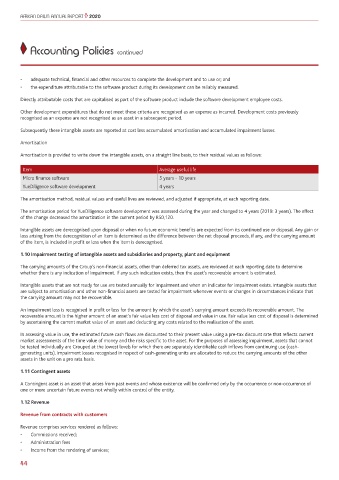
        Amortisation is provided to write down the intangible assets, on a straight line basis, to their residual values as follows:

         Item                                            Average useful life
         Micro finance software                          5 years - 10 years
         YueDiligence software development               4 years

        The amortisation method, residual values and useful lives are reviewed, and adjusted if appropriate, at each reporting date.

        The amortisation period for YueDiligence software development was assessed during the year and changed to 4 years (2019: 3 years). The effect
        of the change decreased the amortization in the current period by R50,120.

        Intangible assets are derecognised upon disposal or when no future economic benefits are expected from its continued use or disposal. Any gain or
        loss arising from the derecognition of an item is determined as the difference between the net disposal proceeds, if any, and the carrying amount
        of the item, is included in profit or loss when the item is derecognised.

        1.10 Impairment testing of intangible assets and subsidiaries and property, plant and equipment

        The carrying amounts of the Group’s non-financial assets, other than deferred tax assets, are reviewed at each reporting date to determine
        whether there is any indication of impairment. If any such indication exists, then the asset’s recoverable amount is estimated.

        Intangible assets that are not ready for use are tested annually for impairment and when an indicator for impairment exists. Intangible assets that
        are subject to amortisation and other non-financial assets are tested for impairment whenever events or changes in circumstances indicate that
        the carrying amount may not be recoverable.
        An impairment loss is recognised in profit or loss for the amount by which the asset’s carrying amount exceeds its recoverable amount. The
        recoverable amount is the higher amount of an asset’s fair value less cost of disposal and value in use. Fair value less cost of disposal is determined
        by ascertaining the current market value of an asset and deducting any costs related to the realisation of the asset.

        In assessing value in use, the estimated future cash flows are discounted to their present value using a pre-tax discount rate that reflects current
        market assessments of the time value of money and the risks specific to the asset. For the purposes of assessing impairment, assets that cannot
        be tested individually are Grouped at the lowest levels for which there are separately identifiable cash inflows from continuing use (cash-
        generating units). Impairment losses recognised in respect of cash-generating units are allocated to reduce the carrying amounts of the other
        assets in the unit on a pro rata basis.

        1.11 Contingent assets

        A Contingent asset is an asset that arises from past events and whose existence will be confirmed only by the occurrence or non-occurrence of
        one or more uncertain future events not wholly within control of the entity.

        1.12 Revenue
        Revenue from contracts with customers

        Revenue comprises services rendered as follows:
        •   Commissions received;
        •   Administration fees
        •   Income from the rendering of services;

        44

