


Page 53 - annualreport2020
P. 53
AFRICAN DAWN ANNUAL REPORT   2020


            Accounting Policies continued


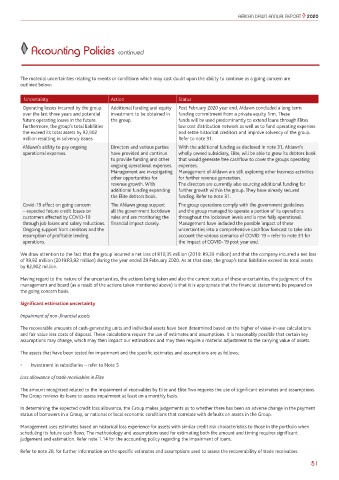
        The material uncertainties relating to events or conditions which may cast doubt upon the ability to continue as a going concern are
        outlined below:

          Uncertainty                   Action                  Status
         Operating losses incurred by the group   Additional funding and equity  Post February 2020 year end, Afdawn concluded a long term
         over the last three years and potential   investment to be obtained in   funding commitment from a private equity firm. These
         future operating losses in the future.   the group.    funds will be used predominantly to extend loans through Elites
         Furthermore, the group’s total liabilities             low cost distribution network as well as to fund operating expenses
         the exceed its total assets by R2,902                  and settle historical creditors and improve solvency of the group.
         million resulting in solvency issues.                  Refer to note 31.
         Afdawn's ability to pay ongoing  Directors and various parties   With the additional funding as disclosed in note 31, Afdawn’s
         operational expenses.          have provided and continue   wholly owned subsidiary, Elite, will be able to grow its debtors book
                                        to provide funding and other   that would generate free cashflow to cover the groups operating
                                        ongoing operational expenses.  expenses.
                                        Management are investigating  Management of Afdawn are still exploring other business activities
                                        other opportunities for   for further revenue generation.
                                        revenue growth. With    The directors are currently also sourcing additional funding for
                                        additional funding expanding  further growth within the group. They have already secured
                                        the Elite debtors book.  funding. Refer to note 31.
         Covid-19 effect on going concern   The Afdawn group support   The group operations comply with the government guidelines
         – expected future credit losses on   all the government lockdown   and the group managed to operate a portion of its operations
         customers affected by COVID-19   rules and are monitoring the   throughout the lockdown levels and is now fully operational.
         through job losses and salary reductions.  financial impact closely.  Management have included the possible impact of these
         Ongoing support from creditors and the                 uncertainties into a comprehensive cashflow forecast to take into
         resumption of profitable lending                       account the various scenarios of COVID 19 – refer to note 31 for
         operations.                                            the impact of COVID-19 post year end.

        We draw attention to the fact that the group incurred a net loss of R10,35 million (2019: R9,39 million) and that the company incurred a net loss
        of R9,92 million (2019:R3,92 million) during the year ended 29 February 2020. As at that date, the group’s total liabilities exceed its total assets
        by R2,902 million.
        Having regard to the nature of the uncertainties, the actions being taken and also the current status of these uncertainties, the judgment of the
        management and board (as a result of the actions taken mentioned above) is that it is appropriate that the financial statements be prepared on
        the going concern basis.

        Significant estimation uncertainty

        Impairment of non-financial assets
        The recoverable amounts of cash-generating units and individual assets have been determined based on the higher of value-in-use calculations
        and fair value less costs of disposal. These calculations require the use of estimates and assumptions. It is reasonably possible that certain key
        assumptions may change, which may then impact our estimations and may then require a material adjustment to the carrying value of assets.

        The assets that have been tested for impairment and the specific estimates and assumptions are as follows:
        •   Investment in subsidiaries – refer to Note 5

        Loss allowance of trade receivables in Elite

        The amount recognised related to the impairment of receivables by Elite and Elite Two requires the use of significant estimates and assumptions.
        The Group reviews its loans to assess impairment at least on a monthly basis.

        In determining the expected credit loss allowance, the Group makes judgements as to whether there has been an adverse change in the payment
        status of borrowers in a Group, or national or local economic conditions that correlate with defaults on assets in the Group.

        Management uses estimates based on historical loss experience for assets with similar credit risk characteristics to those in the portfolio when
        scheduling its future cash flows. The methodology and assumptions used for estimating both the amount and timing requires significant
        judgement and estimation. Refer note 1.14 for the accounting policy regarding the impairment of loans.
        Refer to note 28, for further information on the specific estimates and assumptions used to assess the recoverability of trade receivables.

                                                                                                              51

